
Kalpesh Kinariwala is the founder of Pantheon, a Dubai company he spent years building as a residential real estate developer before reframing it in August 2026 as Pantheon: Art, Culture, Real Estate, with a cultural arm called HOP Events at its centre. In what he told GTN for this feature, he says the shift came from something he noticed while building homes: a development succeeds or fails on far more than architecture, location or square footage. It succeeds when people actually form a community around it.
He runs his own Instagram and posts under his LinkedIn profile, both under his own name rather than the company’s, which fits how personally he talks about the pivot: not as a rebrand, but as a change in what he decided Pantheon was actually in the business of.
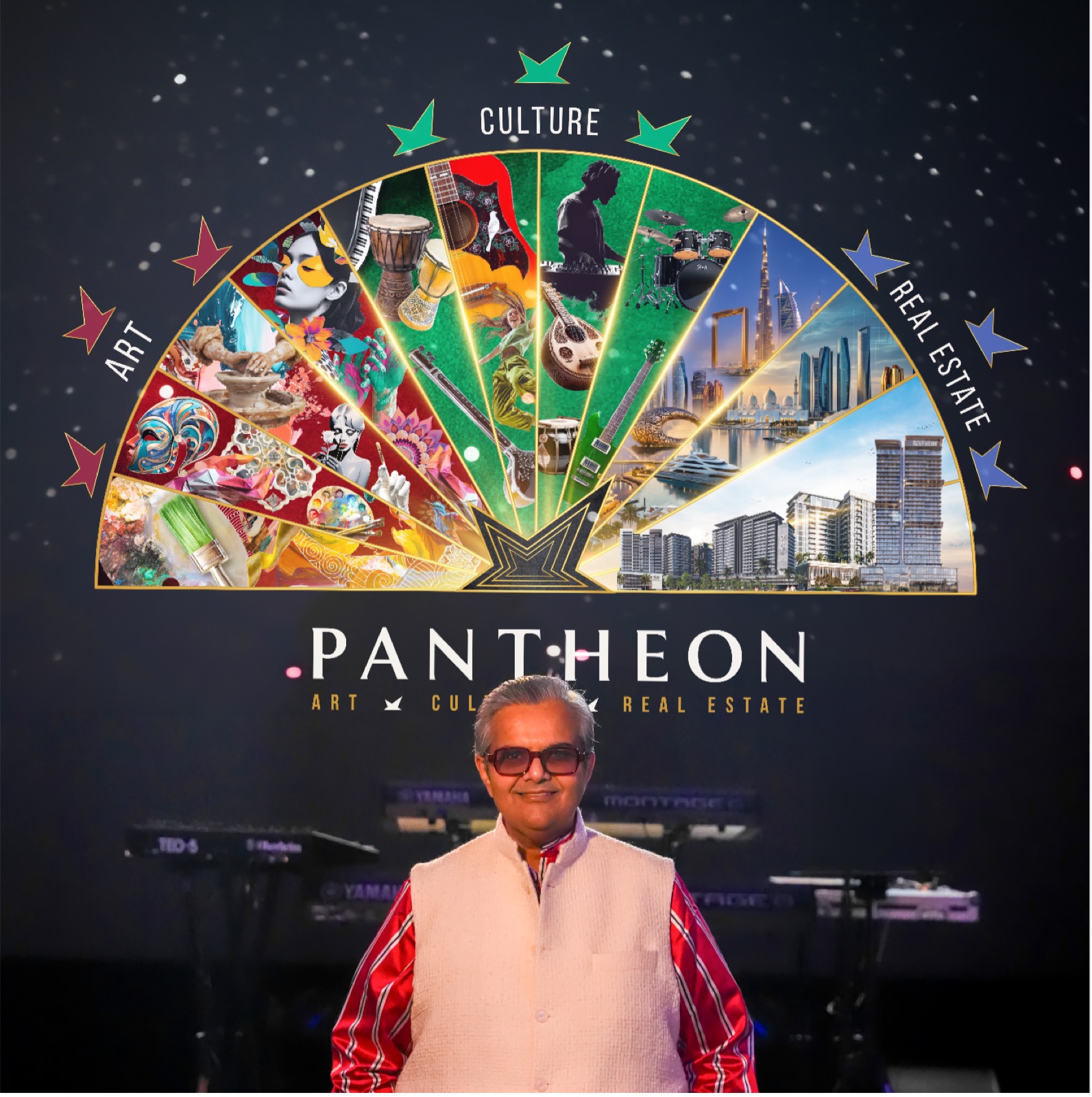
Buildings create addresses, culture creates belonging
Kalpesh Kinariwala has spent years building communities across Dubai. As Founder and Chairman of Pantheon, he has helped shape neighbourhoods, create homes and deliver developments designed around the lives of the people who live within them. Yet for him, real estate was never simply about constructing buildings. From the earliest days, the focus was on creating environments where people could connect, grow and build a sense of belonging.
That perspective has remained remarkably consistent throughout his journey, even as Pantheon itself has evolved.
Today, Pantheon stands for Art, Culture & Real Estate (ACR), a vision that brings together three disciplines often viewed separately. For Kalpesh, however, they have always been part of the same conversation.
The question was never simply how to build a better development. The question was always how to build a stronger community.
“Buildings create addresses. Culture creates belonging.”
It is a belief that sits at the heart of everything Pantheon does.
Real estate provides the foundation. It shapes the places where people live, work and come together. But the spaces people remember most are often defined by something less tangible. They are defined by the experiences shared by the people who inhabit them and the sense of connection people feel to one another.
For Kalpesh, those elements are not separate: they are what give his work meaning.
As Pantheon continued to grow, that understanding led naturally to a broader vision. If communities are strengthened through shared experiences, then culture has an important role to play in shaping them.
What began as a real estate company expanded into something more holistic: a platform focused on creating places, experiences and opportunities that bring people together.
The result was not a move away from real estate, but an extension of its purpose.
Pantheon ACR represents the coming together of physical spaces, cultural experiences and human connection under a single philosophy of community building.
One of the clearest expressions of that philosophy is HOP Events, Pantheon’s cultural and entertainment platform.
Through large-scale concerts, artist partnerships, touring productions and original cultural concepts such as Borderless Melodies, HOP creates opportunities for people from different backgrounds, generations and cultures to discover common ground through shared experiences.
For Kalpesh, these initiatives are not separate from the company’s larger mission. They are another way of achieving it.
Whether through a residential community or a live cultural experience, the objective remains the same: bringing people together.
Underneath every Pantheon venture is a simple conviction that strong communities do not happen by accident. They are built intentionally through trust, relationships and meaningful moments of connection.
That belief influences everything from partnerships and projects to the people the company chooses to work alongside. It is also why authenticity matters so deeply to him.
At its heart, Pantheon’s vision has never been about scale for the sake of scale. It is not about being the largest developer, the tallest tower or the loudest voice in the room. It is about creating places, experiences and communities that resonate on a deeper human level.
Spaces people are proud to call home. Experiences they remember. Communities they feel part of.
Because when people connect with something emotionally, they don’t just engage with it. They become part of it. And that belief continues to shape everything Pantheon builds.
From residential developer to Lucky Ali’s touring partner
The clearest proof point Kinariwala points to is HOP Events becoming the exclusive global touring partner for musician Lucky Ali’s eight-city world tour, confirmed for 2027 and covering destinations including Doha, Singapore and London, with more cities still being finalised. Lucky Ali has spent more than three decades building a reputation for being selective about who he works with, and Kinariwala describes earning that trust, alongside the artist’s management team at Farmhouse Music (led by Taawwuz Ali and Mezaan Maqdoom Ali), as one of the achievements he is proudest of. Not because it is a big concert deal, in his words, but because it proves the whole idea behind Pantheon’s reframe: that culture and real estate can genuinely reinforce each other rather than just sitting next to each other on a balance sheet.
What a developer actually learns building homes
Kinariwala’s account of his own career keeps returning to one lesson: communities aren’t created by buildings alone. They come from the relationships, creativity and shared experiences that happen around a place. That belief eventually produced HOP Events, and it’s now the design principle behind Borderless Melodies, the cultural concept the team is building to bring international artists and multicultural audiences together with Dubai as the meeting point.
He is candid that this is a slower way to grow than simply adding units to a sales pipeline. A cultural programme doesn’t close the way a villa sale closes. It takes years of consistent programming before an audience trusts a name enough to show up for whatever comes next, in roughly the same way a development takes years before residents start calling it a neighbourhood instead of a postcode.
The development arm that still has to deliver the homes
The culture story sits on top of a real estate business that still has to function like one. Pantheon Development, the group’s dedicated development arm, lists live projects across Jumeirah Village Circle, Jumeirah Village Triangle, Al Wasl Gate and a newer push into Ras Al Khaimah, alongside a run of industry awards and coverage in outlets like Construction Week and Arabian Business. That is the side of the business the art and culture reframe has to keep funding, and it is also the credibility the cultural pivot borrows from: a developer with actual delivered homes behind it is a very different pitch to an events company with none.
A different bet to Dubai’s biggest developers
The reframe puts Pantheon in an unusual spot next to Dubai’s larger developers, several of which build cultural or retail arms as an extension of the real estate business rather than the other way round. Aldar Properties, across the border in Abu Dhabi, is the closest comparison: a developer that expanded into managing entire districts, malls and hospitality assets alongside the homes it builds. Kinariwala’s bet is narrower on purpose. Rather than diversifying into every adjacent business a large balance sheet can support, Pantheon picked one adjacency, culture, and is trying to make it structural to the company rather than a side project.
Renaming the company also meant re-registering how Pantheon presents itself legally, a step any UAE business making a similar pivot eventually has to take through formal trademark registration, so the new name and everything built under it stays protected as the company grows into territory it didn’t originally start in.
The advice he says he’d give his younger self
Asked what he’d tell himself starting out, Kinariwala’s answer is close to a mission statement for how Pantheon now operates: be patient, stay authentic, build relationships before transactions, and don’t trade authenticity for a short-term opportunity. Dubai’s property market has kept moving fast around him while he builds the slower version of the business. Whether that patience pays off at the scale he’s betting on is still being tested, one HOP Events production at a time, starting with an eight-city tour that hasn’t opened its first show yet. For a company that started out selling apartments, betting its next chapter on a touring musician is not a small pivot, and Kinariwala knows it.
Read next: Aigul: The Abu Dhabi Photographer Whose Eye Was Trained in Italy · Rica Hernandez: A Salon Built on One Promise · Ameer Hamza: The Accountant Building Abu Dhabi SMEs a Safety Net